

Prototype your token structure in days. Ship it in six weeks.
Draw the asset's lifecycle as one visual workflow: its states, roles, and payment rules.
Toolblox compiles it into a contract system assembled from independently audited building blocks: cheap to change, fast to audit, and readable by your lawyer, your board, and your auditor. Fixed-fee two-week audit to start.


The diagram is the contract.
Not a product you onboard. A platform we operate so your engagement gets the speed of AI design and the safety of pre-verified composition.
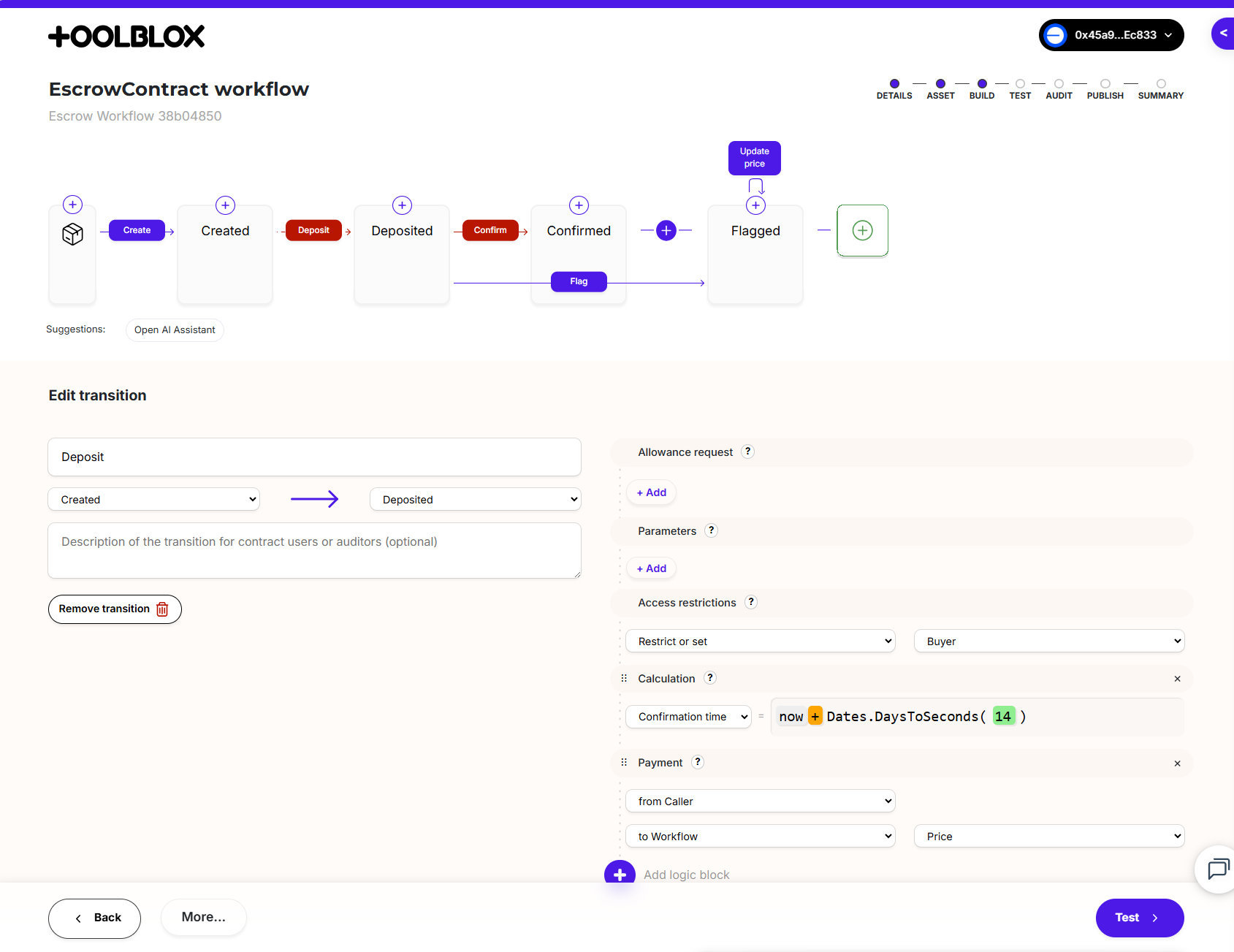
Turn business logic into a reviewable workflow.
States, transitions, and rules mapped onto a workflow non-technical stakeholders can read. The same workflow compiles into the audit-ready smart contract we ship to your custody.
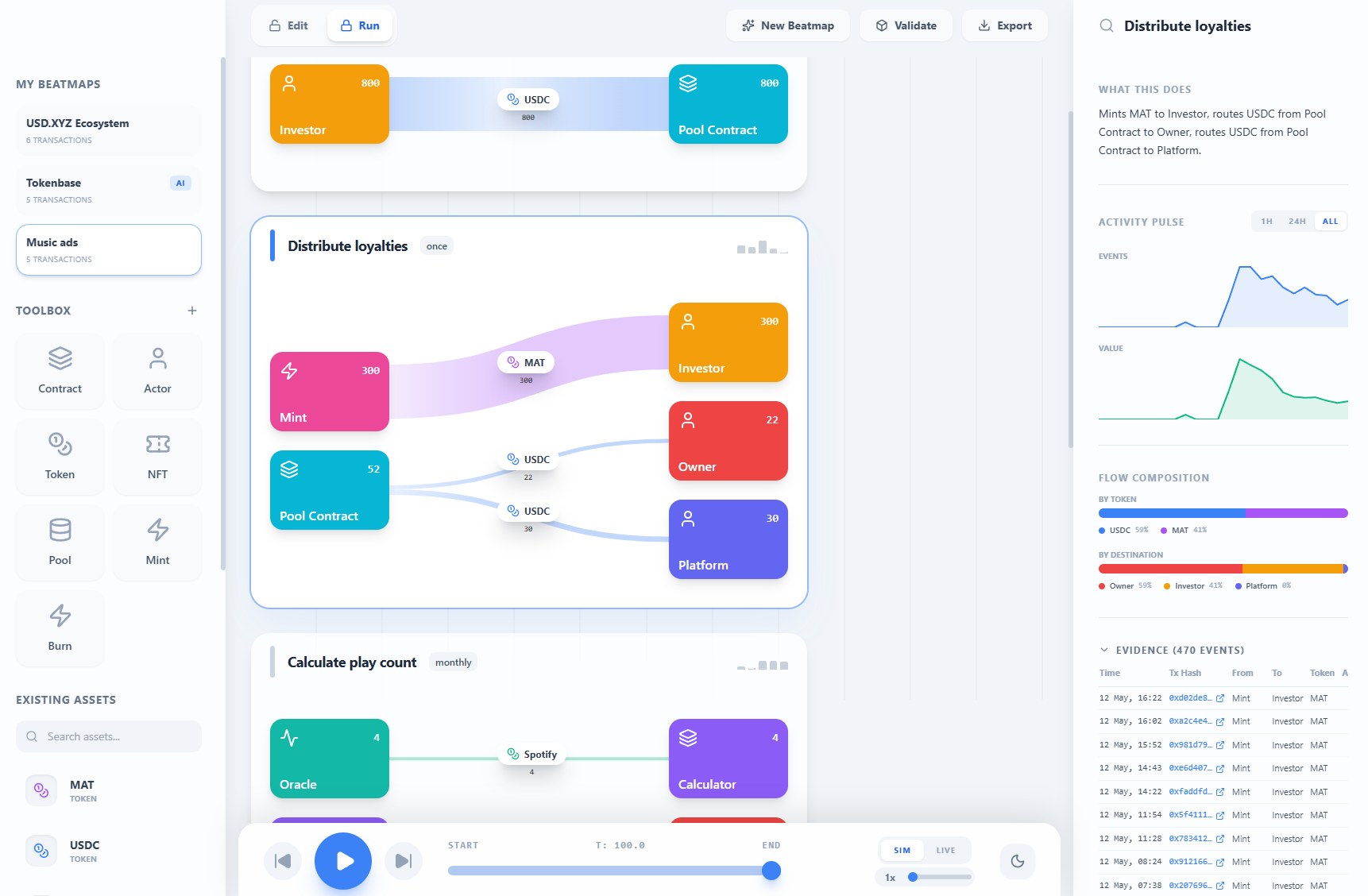
See cashflows and token movement across the system.
Streamed live from the chain. Every issuance, redemption, and transfer plotted on a single map so operators can spot drift before it becomes an incident.
How we ship a tokenized product.
Four phases, audit through operations. Each engagement is scoped to the asset, never to a fixed feature list.
Audit the asset and the deal
Map deal logic, jurisdiction, custody, and edge cases with your team. Two-week fixed-fee.
Architect the workflow with AI
AI designs the flow. Contracts stay composed from pre-verified modules, and AI never writes the bytecode that holds your reserves.
Compose modules and deploy
Audit-friendly modules go live on production chains under your custody.
Operate the live system
Governance, contract upgrades, monitoring, and edge-case response. We run it with you.
Why composition beats custom code.
A first-of-kind structure is a stack of unknowns. Composing it from independently audited building blocks makes each one cheap to test.
Change is cheap.
First-of-kind structures are always wrong on draft one. When legal adds a redemption-notice state, we redraw and recompile in minutes, not a re-scoped dev contract.
Audit in hours, not months.
Custom code means a custom audit: weeks of queue, tens of thousands in fees, reopened on every change. Composition from pre-verified blocks means reviewers check a small, readable composition.
The prototype is the product.
The MVP you test with counterparties hardens into the production system. Nothing is thrown away.

Versus what you would do today.
| Build in-house | Dev agency | Tokenization platform | Toolblox Studio | |
|---|---|---|---|---|
| Time to a working MVP | 12 to 18 months | 9 to 12 months | Days, if your deal fits the template | Days to prototype, six weeks to production |
| First-version cost | €150k+ in team time | €50k to €150k | Low entry, then per-asset and platform fees | Fixed-fee audit, then a scoped build |
| First-of-kind structure? | Yes, at full custom cost | Usually, at agency speed | No, the deal bends to fit the schema | Yes, blocks compose into custom lifecycles |
| Can non-developers read the logic? | No | No | Their dashboard, their abstractions | Yes, the workflow diagram is the contract |
| When legal changes a rule | New sprint | Change request, new invoice | Only if the template allows | Redraw and recompile, minutes to days |
| Audit burden | Full custom audit: weeks, €30k to €100k+ (indicative) | Same | Platform is audited; your customizations are not | Pre-verified blocks; composition review in hours to days |
| What you own at the end | Everything, including the maintenance burden | Code and, hopefully, docs | A tenancy | Full source, keys, and a 12-month operations SLA |
Big Four alternative available from €400k. Deliverable: a deck.
Built for assets without an ISIN.
The assets worth tokenizing first rarely have an ISIN. They are defined by their own terms, not a standard schema, which is exactly why a template platform cannot hold them. Toolblox composes each structure from independently audited building blocks, so a first-of-kind deal becomes a design problem instead of a custom-code project. The fastest-growing tokenization theses target exactly these assets.
Template platforms serve the eighth deal in a category. Toolblox is for the first.
How an engagement works.
Audit is fixed-fee. Build and operations scoped to the asset. We respond to audit requests within 48 hours.

Money, contracts, and the assets behind them are getting an upgrade. Tokenization is how the next decade of finance gets built. Assets that move at internet speed, settle without intermediaries, and stay accountable to their holders.
We engineer the parts where mistakes are not recoverable. The deal logic. The custody. The settlement. We use AI to design fast. We use pre-verified modules to keep contracts auditable. And we operate every system we deploy. The tooling we built across four years and thousands of designed lifecycles is the moat we bring to your engagement.
See what tokenization could look like for your asset.
A short conversation with the Toolblox team to scope your asset, surface the edge cases, and identify where AI design plus pre-verified modules can ship the fastest path to a live token.
Questions we get every week.
The short answers. Longer ones happen on the call.
Are you another deck-and-disappear shop?
No. Every engagement ends with a live token, not a slide deck. Production contracts go through third-party audit before they hold real value, and you walk away with the full source, the deployment keys, and no lock-in to our infrastructure. Operations is in scope: we stay through the first depeg, the first dispute, the first redemption surge.
Are these vibe-coded contracts?
No. Pre-verified modules, deterministic composition. Auditors see known-good code, not novel Solidity. AI designs the workflow and the model. Humans verify the modules and sign off the deployment.
How does Toolblox use AI?
Extensively across ideation, workflow design, data modelling, and documentation. The contract code itself is composed from pre-verified building blocks - that part stays deterministic and auditable. AI accelerates the design surface; it does not write the bytecode that holds your reserves.
Why not a generic tokenization platform?
Generic platforms ship a fixed schema and ask you to fit. That works for the eighth deal in a category, not the first one in yours. We engineer the contract, the operations, and the integrations specifically for your deal - and hand over the code at the end.
Who owns the smart contracts?
You do. Full Solidity export, full deployment keys, full operator authority. No lock-in to our infrastructure, no recurring license, no escrowed admin rights. If you decide to operate everything in-house after month twelve, the handoff is already done.
What are the benefits of tokenization?
Programmable settlement, fractional ownership, 24/7 markets, transparent reserves, automated distributions, composability with the rest of on-chain finance, and a path to liquidity that does not depend on a single exchange or transfer agent. The right subset depends on your asset.
Can you build a structure nobody has done before?
That's the point. Blocks are generic; compositions are yours. The audit exists to find the edge cases before the contract does.
For teams who would rather ship than pitch.
Prototype in days, production in six weeks, starting with a fixed-fee two-week audit. Designed by us, owned by you, operated together.